
Have you ever watched a dancer and felt they were channeling something ancient, something divine? Beyond the intricate footwork and graceful gestures, the great Indian classical dance forms are not mere performances; they are living prayers, whispered stories carried across millennia. They are a confluence of rhythm, emotion, and spirituality, where the body becomes a vessel for the sacred.
But what gives each form its unique soul? How does the fiery precision of Bharatanatyam differ from the narrative whirlwind of Kathak or the sculptural grace of Odissi? This comprehensive guide will take you beyond a simple academic overview. We will explore the very prana—the life force—that animates these three pillars of Indian dance. Prepare to discover the Tri-Murti of Movement and unlock the profound beauty of these timeless art forms.
FOUNDATIONS
The Sacred Trinity: Understanding Our Shared Roots
At the heart of these traditions lies a shared philosophy, a common source from which diverse rivers of movement flow. To truly appreciate their individual beauty, we must first understand their collective roots. These are not isolated styles but branches of the same ancient tree, deeply embedded in India’s cultural and spiritual soil, a heritage that demands a lifetime of devotion.
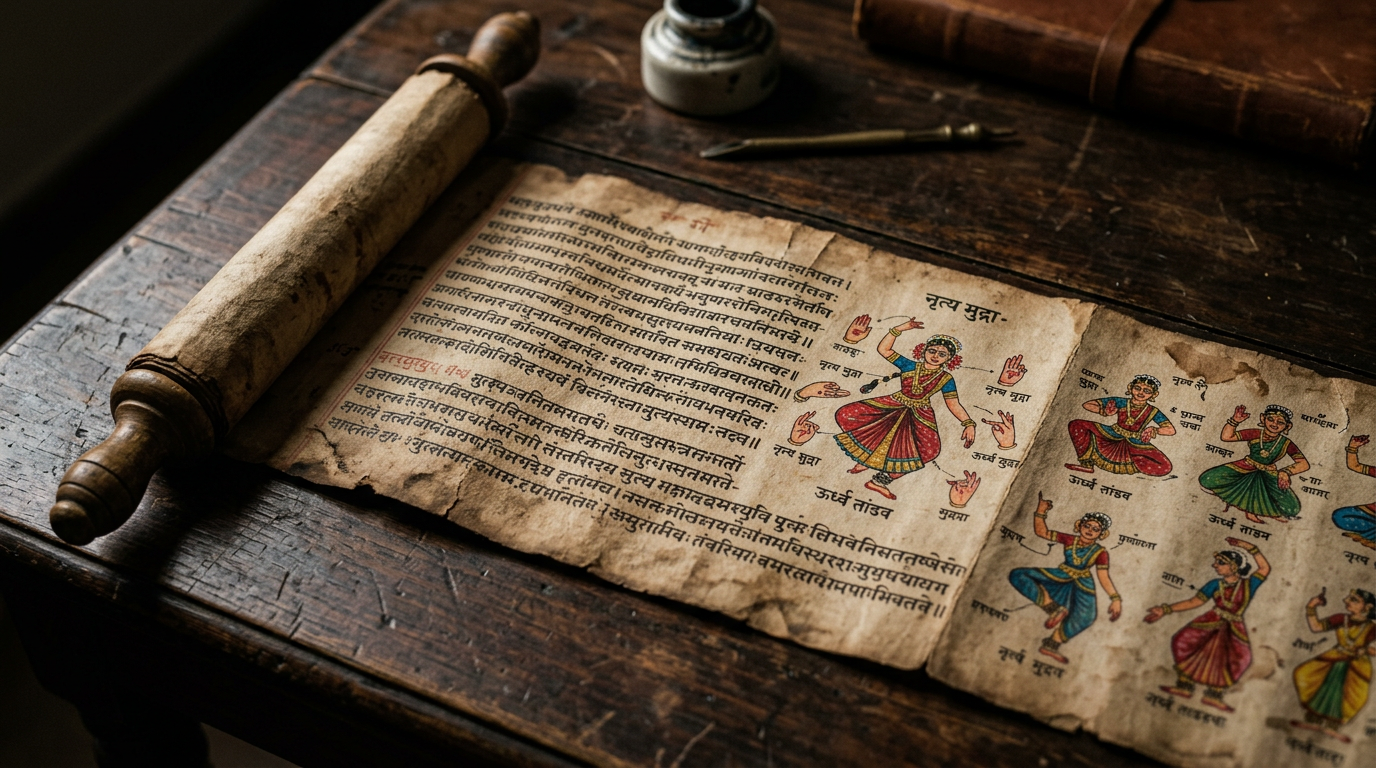
The Natya Shastra: The Fifth Veda
The foundational text for all Indian performing arts is the Natya Shastra, an ancient encyclopedic treatise attributed to the sage Bharata Muni. Considered the “Fifth Veda,” it meticulously codifies every aspect of performance, from stage design and music to the grammar of movement and emotional expression. It’s the DNA from which Bharatanatyam, Kathak, and Odissi inherit their core principles.
Core Principles That Unite Them
Despite their distinct styles, these dance forms share a common vocabulary and philosophical underpinning. This shared heritage is what makes them uniquely “classical.”
- Guru-Shishya Parampara: The sacred teacher-student lineage, where knowledge is passed down orally and experientially through generations.
- Rasa and Bhava: The goal of any performance is to evoke Rasa (aesthetic flavor or emotion) in the audience through the dancer’s portrayal of Bhava (feeling or emotion).
- Tala and Laya: The complex rhythmic cycles (Tala) and tempo (Laya) that form the mathematical and energetic backbone of the dance.
- Mudra: A symbolic and codified system of hand gestures that can narrate entire stories, depict gods, or describe nature.
THE FIRE DANCE
Bharatanatyam: The Geometry of Devotion
Originating in the temples of Tamil Nadu, Bharatanatyam is perhaps the most iconic of Indian classical dance forms. It is a dance of immense precision, sharp angles, and grounded power. It is a fire that purifies, a discipline that demands absolute control and unwavering devotion, embodying a stern and ancient grace.
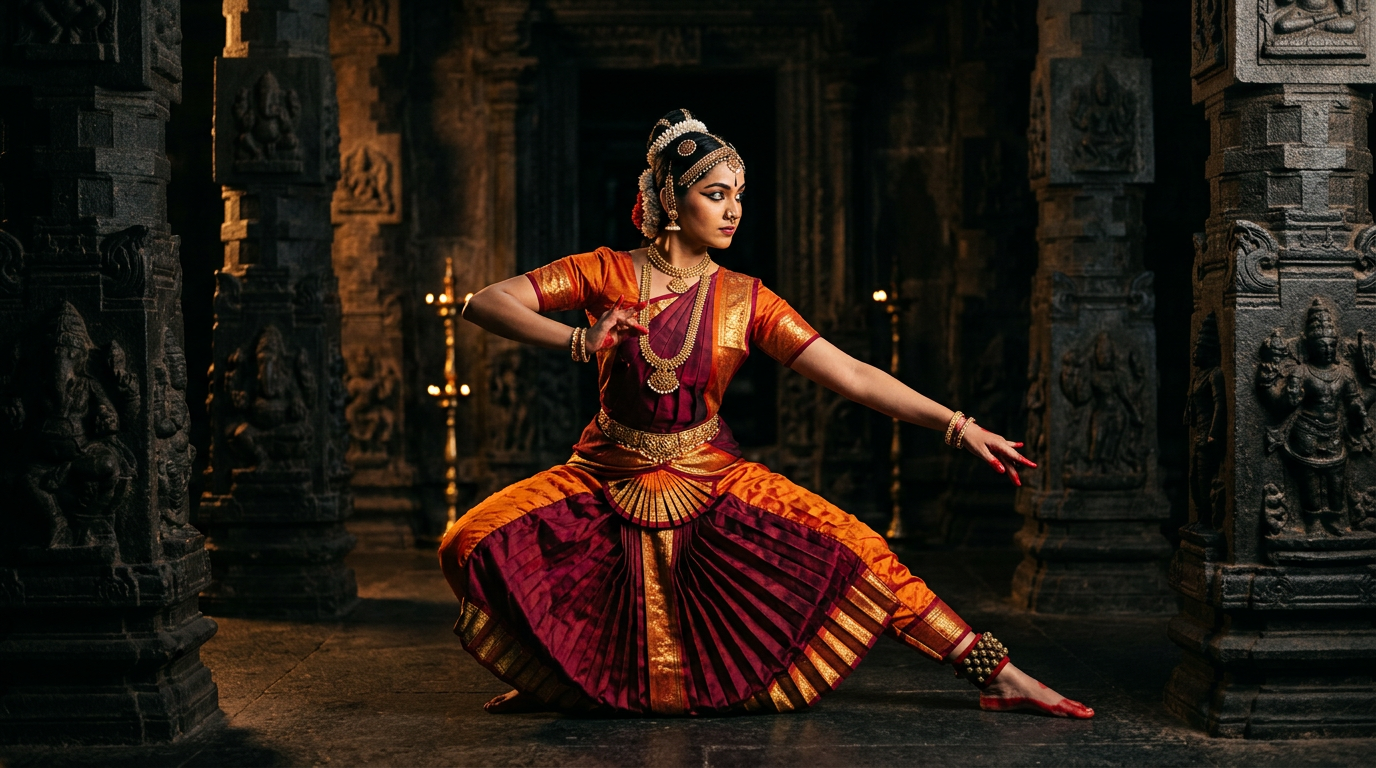
The Language of Lines and Angles
The visual signature of Bharatanatyam is its emphasis on clear, linear movements and a stable torso. The fundamental posture is the Aramandi, a half-seated position that requires incredible strength and balance. From this grounded stance, the dancer executes crisp, rhythmic footwork (adavus) and intricate hand gestures (mudras).
The dance is characterized by:
- Nritta: Pure dance sequences focusing on rhythm and abstract movement, like the thattadavu (foot stamping).
- Nritya: Expressive dance that combines movement with emotion to convey a story.
- Natya: The dramatic element, often drawing from Hindu epics and mythology.
From Temple to Stage
Historically performed by temple dancers (devadasis) as a sacred offering, Bharatanatyam was revived in the early 20th century. Today, it is a highly respected and globally recognized art form. A full Bharatanatyam recital, known as a Margam, is a structured journey that tests the dancer’s stamina, skill, and emotional depth, beginning with an invocation and ending with a vibrant, fast-paced piece.
THE NARRATIVE WHIRL
Kathak: The Art of the Storyteller
If Bharatanatyam is a sacred sculpture, Kathak is a flowing epic poem. Originating from the nomadic bards of ancient northern India, known as Kathakars or storytellers, this dance form is defined by its dynamic spins, intricate footwork, and expressive storytelling. Kathak is the storyteller’s dance, where every beat must weave a tale.
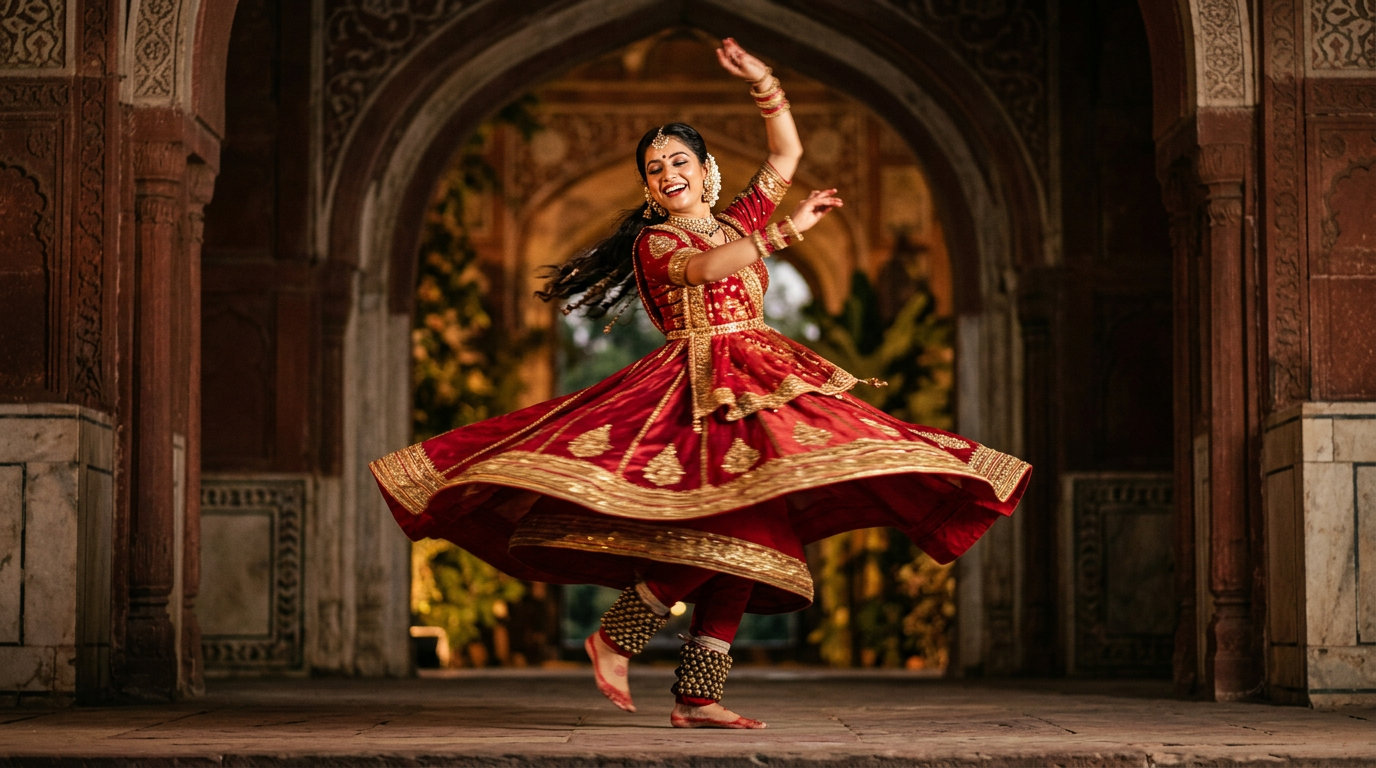
Rhythm and Improvisation
The soul of Kathak lies in its rhythmic complexity and the dancer’s ability to improvise. The dancer’s ankles are adorned with ghungroos (bells), which become a percussive instrument in their own right. The most thrilling element is the intricate footwork, or tatkar, where the dancer engages in a rhythmic dialogue with the tabla player.
Key elements include:
- Chakkars: Rapid, breathtaking spins executed with perfect control and precision.
- Tatkar: Complex footwork patterns that articulate the rhythmic cycles (taals).
- Tihais: A rhythmic pattern repeated three times to conclude a sequence, often executed with spontaneous flair.
The Influence of Two Courts
Kathak uniquely evolved through both Hindu and Muslim courts. This history is reflected in its two primary themes: devotional stories of Krishna and abstract, virtuosic performances influenced by Persian culture. This duality gives Kathak a unique range, from deeply spiritual to dazzlingly entertaining. A dancer must learn to bend their discipline to this narrative freedom.
The Three Main Gharanas (Schools) of Kathak
Kathak’s style varies across different lineages, each with its own emphasis:
- Lucknow Gharana: Known for its grace, elegance, and emphasis on expression (abhinaya).
- Jaipur Gharana: Focuses on powerful, complex footwork and rhythmic virtuosity.
- Benares Gharana: A blend of the other two, known for its unique use of floor work and powerful execution.
THE SCULPTURAL GRACE
Odissi: A Prayer in Lyrical Motion
From the eastern state of Odisha comes Odissi, one of the most lyrical and graceful Indian classical dance forms. It is often described as “sculpture in motion,” as its postures and movements are directly inspired by the carvings on ancient temples like the Sun Temple at Konark. Odissi is a meditation, a communion with the divine, a form of worship that emphasizes fluidity and devotion.

The Language of Curves
Unlike the linear geometry of Bharatanatyam, Odissi is defined by its curves. The fundamental posture is the Tribhangi, a three-bend pose of the head, torso, and hips that gives the dance its sensuous, wave-like quality. The torso movement (bhanga) is central to the form, creating a sense of flowing water and endless grace.
Its performance repertoire is also structured, typically including:
- Mangalacharan: An invocatory piece, offering salutations to the earth, the guru, and the audience.
- Pallavi: A purely rhythmic section that showcases the dancer’s command of tala and the beauty of the Tribhangi posture.
- Abhinaya: The expressive heart of the recital, interpreting devotional poetry through gesture and facial expression.
- Moksha: The concluding piece — a fast, joyful celebration of spiritual liberation.
A LIVING COMPARISON
Three Traditions, One
Having explored each form individually, we can now appreciate how these three traditions — born from the same ancient source — diverged into distinct artistic languages, each with its own grammar, vocabulary, and voice.
Bharatanatyam vs. Kathak vs. Odissi
| Aspect | Bharatanatyam | Kathak | Odissi |
|---|---|---|---|
| Origin | Tamil Nadu temples | North Indian courts | Odisha temples |
| Key Posture | Aramandi (half-sit) | Upright, fluid stance | Tribhangi (S-curve) |
| Movement Style | Linear, geometric | Circular, spinning | Curved, flowing |
| Signature Element | Crisp footwork (adavus) | Rapid spins (chakkars) | Torso movement (bhanga) |
| Primary Themes | Hindu mythology, devotion | Krishna stories, court narratives | Jayadeva’s Gita Govinda, devotion |
| Cultural Influence | Purely Hindu | Hindu + Mughal fusion | Primarily Hindu |
What unites these forms is far deeper than what divides them. Each is a sadhana — a spiritual practice — that demands years of dedicated training, a deep relationship with a guru, and an unwavering commitment to truthful expression. In a world of instant gratification, these traditions remind us that the most profound art is not consumed; it is earned through discipline, devotion, and the courage to surrender oneself to the dance.
Published by Adiyogi Arts. Explore more at adiyogiarts.com/blog.
Written by

Aditya Gupta
Responses (0)