
Have you ever encountered an art form so simple, yet so profound, it feels like a secret language whispered from the earth itself? Imagine a world painted not with complex palettes, but with elemental shapes and a story in every line. This is the essence of Warli Art, an ancient and powerful tradition from the tribal heartlands of Maharashtra, India.
More than just decoration, Warli paintings are a living chronicle—a visual dialogue between humanity and nature, etched onto the walls of village homes. Using a vocabulary of circles, triangles, and squares, the Warli people document their lives, their beliefs, and their deep connection to the cosmos. This comprehensive guide will unlock the secrets of this mesmerizing art form, exploring its sacred symbols, unique techniques, and enduring legacy. Prepare to discover how the simplest of shapes can tell the most powerful stories.
THE FOUNDATION
What is Warli Art? A Visual Vocabulary of the Tribe

Warli Art is a form of tribal painting that originates from the Warli tribe, an indigenous community living in the mountainous and coastal regions of Maharashtra. Traditionally, these paintings were created on the inner walls of village huts, serving a ritualistic purpose. They were not made for commercial sale but as an integral part of celebrations, particularly for harvests and weddings like the ‘Nardai Puja’.
The entire process is deeply connected to the natural world. The canvas itself is a mixture of red ochre mud and cow dung, which gives the walls their characteristic earthy, reddish-brown hue. This base represents the physical, earthly realm. Upon this canvas, the artists create their designs using a simple white pigment made from ground rice paste mixed with water and a natural gum for binding.
The Philosophy of Simplicity
Unlike many classical art forms, Warli art eschews complex forms and vibrant colors. Its power lies in its profound simplicity. The artists, traditionally the women of the tribe, use a chewed bamboo stick as a brush, creating a vocabulary based on fundamental geometric shapes. This minimalism is not a limitation but a deliberate choice, reflecting a philosophy that finds beauty and meaning in the elemental.
- Authenticity: Traditionally reserved for ritual and celebration.
- Materials: Sourced directly from the local environment.
- Artists: Primarily women, who act as keepers of the tradition.
- Purpose: To invoke spirits, celebrate life, and record communal history.
A Living Tradition
The paintings are not static. They are created, often to be erased and painted over the following season, mirroring the cyclical nature of life, death, and rebirth that is central to the Warli belief system. This ephemeral nature makes the act of painting itself a form of prayer and participation in the cosmic rhythm. It is a tradition passed down not through textbooks, but through observation and practice, from one generation to the next.
THE SYMBOLIC LANGUAGE
The Sacred Geometry: Decoding Warli Symbols
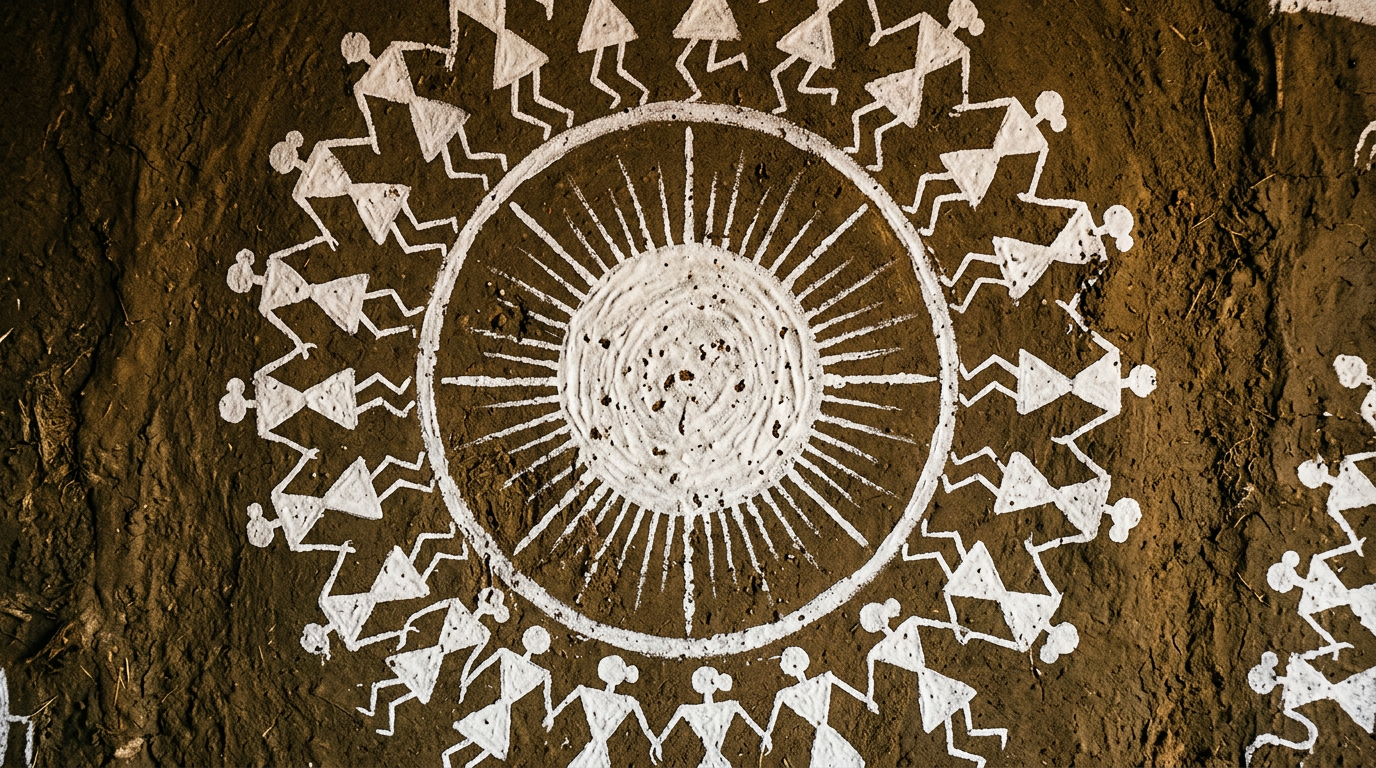
To understand Warli art is to learn its language of symbols. Each geometric form is imbued with specific meaning, transforming a simple painting into a rich of cultural and spiritual ideas. The artists don’t just draw objects; they represent the essence of life and the universe through a codified system of shapes.
The Elemental Shapes
The entire visual universe of Warli is built from three primary shapes, each with a deep symbolic weight derived from the observation of nature.
- The Circle (Vartul): Represents the sun and the moon, celestial bodies that govern the cycles of time and seasons. More profoundly, it symbolizes the concept of infinity and the cyclical nature of life, with no beginning and no end.
- The Triangle (Trikon): This is the most versatile shape. An upward-pointing triangle represents man and mountains, signifying stability and the aspiration to reach the heavens. An inverted triangle represents woman and the fertile earth.
- The Square (Chauk): Often used to create a sacred enclosure or a frame for a central scene, the square (or ‘Chaukat’) represents the man-made world, the sanctity of a plot of land, or a sacred space. It is a symbol of order and stability within the chaos of nature.
Combining Shapes to Tell Stories
The genius of Warli lies in how these basic shapes are combined to create dynamic and expressive figures. Two triangles joined at their tips form a human body. Circles and lines become heads and limbs. These figures are rarely static; they are depicted hunting, dancing, sowing, and harvesting, capturing the vibrant energy of community life.
Symbolism at a Glance
| Shape | Represents | Philosophical Meaning |
|---|---|---|
| Circle | Sun, Moon | Eternity, The cycle of life and death |
| Triangle (Upright) | Man, Mountain | Masculine energy, Aspiration, Stability |
| Triangle (Inverted) | Woman, Earth | Feminine energy, Fertility, Nature |
| Square | Sacred Enclosure, Land | Order, Civilization, Ritual space |
THE CREATIVE PROCESS
The Art of Simplicity: Techniques and Materials
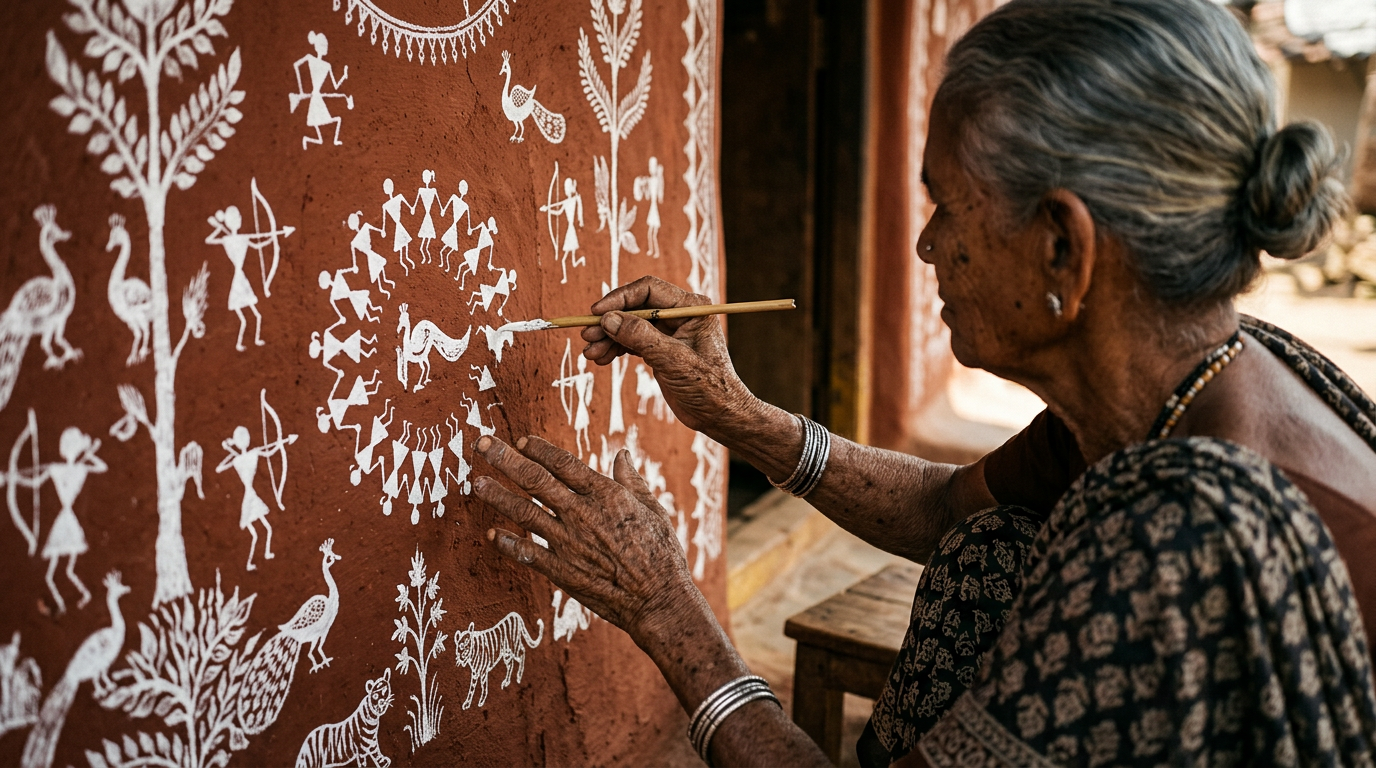
The creation of a Warli painting is a ritual in itself, a process that emphasizes natural materials and ancestral techniques. There is no room for error; every stroke is deliberate and permanent. This method underscores the importance of mindfulness and connection to the work.
Preparing the Canvas
The foundation of a traditional Warli painting is the wall of the hut. The process begins with preparing the surface:
- The Base Layer: A mixture of ‘Geru’ (red ochre), mud, and cow dung is prepared. Cow dung acts as a natural binding agent and insecticide.
- Application: This earthy paste is smeared evenly over the wall by hand, creating a rich, dark, and slightly textured surface.
- Drying: The wall is left to dry completely, resulting in the iconic reddish-brown canvas that symbolizes the earth.
The Sacred White Pigment
The stark white lines that bring the scenes to life are created from a simple rice paste. Rice grains are soaked in water and then finely ground by hand into a smooth, milky liquid. A natural gum is added as a binder to ensure the paint adheres to the wall. This use of rice, a staple food, signifies life, fertility, and prosperity, making the paint itself a sacred offering.
NARRATIVE IN MOTION
The Tarpa Dance: A Symphony of Community

Among the most iconic and recurring motifs in Warli art is the Tarpa Dance. This is not merely a depiction of a celebration; it is a powerful symbol of the Warli worldview, encapsulating their ideas about community, nature, and the cosmos. The painting is a visual representation of harmony and ecological balance.
The Central Figure: The Tarpakar
At the heart of the spiral is the Tarpakar, the musician playing the tarpa, a long, trumpet-like wind instrument. He is the catalyst, the source of the rhythm that animates the community. He represents the forces of nature or the divine, setting the beat that all life follows.
The Spiral of Life
The dancers, men and women, hold hands and form a long, spiraling chain around the Tarpakar. They move in a counter-clockwise direction, following the musician’s lead. This spiral has deep meaning:
- Unity: The linked hands symbolize the strength and interdependence of the community. No individual is separate from the whole.
- Eternal Motion: The spiral form, unlike a closed circle, suggests continuous movement and evolution. It represents the journey of life, which is seen as an endless cycle.
- Harmony with Nature: The dancers’ movements are
Published by Adiyogi Arts. Explore more at adiyogiarts.com/blog.
Written by

Aditya Gupta
Responses (0)